
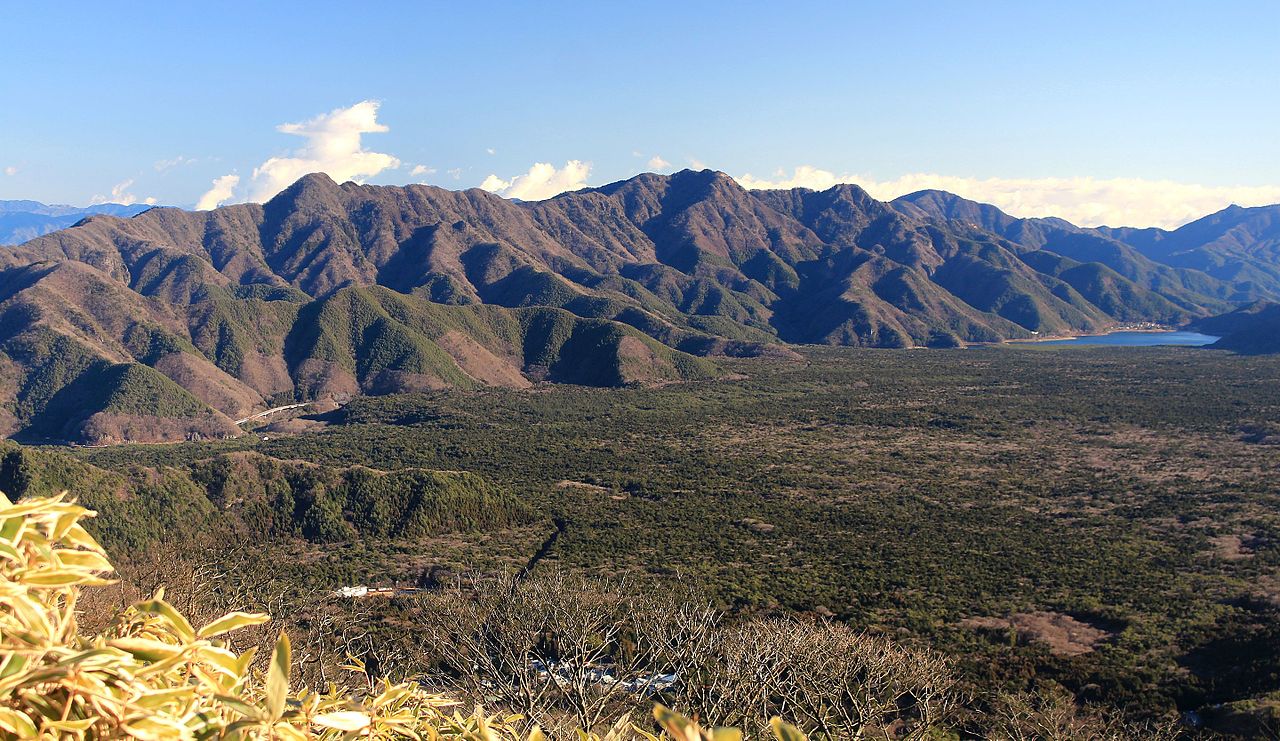
At the northwestern base of Mount Fuji, where ancient lava flows hardened into a twisted landscape of volcanic rock, lies Aokigahara—the Sea of Trees. Here, in this 30-square-kilometer expanse of primordial forest, silence reigns with an otherworldly intensity. The porous basalt beneath your feet drinks sound greedily, swallowing footsteps, voices, even the rustle of wind through leaves until you are left suspended in a cathedral of absolute quiet.
The forest's very name whispers of its nature: Aokigahara, "Aucuba Tree Meadow," though locals know it better as Jukai—the Sea of Trees. From a distance, the canopy does indeed resemble an ocean frozen in time, an endless green expanse that seems to breathe with each shift of light across Mount Fuji's sacred slopes.
Born from Fire and Fury
Aokigahara's dark reputation stems partly from its violent birth. In 864 CE, Mount Fuji erupted with devastating force, spewing torrents of molten rock across the landscape. The lava flows carved new geography, dividing ancient Lake Se-no-umi into what are now Lakes Shōji and Sai, and laying down the twisted foundation upon which this forest would grow. The hardened basalt, riddled with air pockets and caves, created a substrate unlike anywhere else on Earth.
Over the centuries, nature reclaimed this volcanic wasteland with aggressive tenacity. Cryptomeria and Chamaecyparis obtusa thrust upward through cracks in the rock, while Japanese maples and mountain ash spread their canopies overhead. The result is a forest of impossible density, where trails vanish into green tunnels and the outside world simply ceases to exist.
Where Compasses Lose Their Way
Step into Aokigahara's depths and you enter a realm where the ordinary rules of navigation break down. The iron-rich volcanic rock plays havoc with magnetic compasses—place one directly on the forest floor and watch its needle swing away from true north, following the rock's chaotic magnetic fields instead. This phenomenon, though easily corrected by holding the compass at normal height, adds to the forest's reputation as a place where travelers lose their way.
The Japan Ground Self-Defense Force has used these very qualities to their advantage, conducting Ranger navigation training here since 1956. What better place to test one's orienteering skills than a forest that seems designed to confound and disorient?
Yet it is not the magnetic anomalies that truly unnerve visitors—it is the silence. The dense canopy and sound-absorbing rock create an acoustic void so complete that many report feeling as though they've stepped outside the natural world entirely. In this muffled realm, your own heartbeat becomes thunderous, your breathing a storm.
The Ghosts in the Greenwood
Long before Aokigahara gained its modern notoriety, it harbored darker associations. Local folklore speaks of yūrei—restless spirits of the dead who wander the forest's maze-like paths. These tales may have roots in historical truth: the practice of ubasute, the abandonment of elderly family members in remote places during times of extreme hardship, may have continued in these woods well into the 19th century.
The forest's association with death deepened in the modern era, particularly following the 1961 publication of Seichō Matsumoto's novel Nami no Tō (Tower of Waves), which featured a suicide in Aokigahara. Though the forest's reputation predates the novel, this literary connection cemented its place in the popular imagination as a destination for those seeking to end their lives.
Since the 1960s, Aokigahara has earned the grim sobriquet "Suicide Forest." At its peak in 2003, 105 bodies were discovered among the trees, though local officials have since ceased publishing such statistics, hoping to break the forest's morbid cycle of attraction. Signs now stand at trail heads, their messages stark and direct: "Your life is a precious gift from your parents. Please think about them, your siblings, and your children once more. Do not worry alone, and please consult the police."
A Living Wilderness
Yet to focus solely on death is to miss the vibrant life that pulses through Aokigahara's veins. This is a thriving temperate ecosystem, home to Asiatic black bears that lumber through the understory, sika deer that ghost between the trees, and red foxes whose calls pierce the eternal silence. The canopy rings with the songs of great tits and Eurasian jays, while the forest floor rustles with the movement of shrews and field mice.
The plant life displays remarkable diversity despite—or perhaps because of—the challenging volcanic substrate. Ancient hemlocks tower overhead, their branches draped with moisture and moss, while the understory blooms with wild azaleas and mountain laurel. Deeper in the forest's heart, mycoheterotrophic plants thrive in the perpetual shade, drawing sustenance from fungal networks that thread through the volcanic soil like nature's own internet.
At the forest's western edge, where tourist trails lead the curious and the brave, lie the ice caves carved by ancient lava flows. The Fugaku Wind Cave and Narusawa Ice Cave maintain their frigid temperatures year-round, their walls adorned with icicles that never melt. In the Edo period, these natural refrigerators preserved silkworm eggs, supporting Japan's burgeoning silk industry. Today, they offer visitors a glimpse into the geological violence that birthed this strange landscape.
Where Silence Speaks Loudest
To walk Aokigahara's designated trails is to experience a profound disconnection from the modern world. Cell phone signals fail to penetrate the canopy. The urban hum that forms the backdrop of contemporary life falls away completely. In this acoustic void, visitors report a heightened awareness of their own mortality, a confrontation with existential questions that the forest's silence seems to amplify.
The trees themselves bear witness to the forest's troubled reputation. Ribbons of colored tape—left by those who ventured into the depths and needed a path back to light—flutter from branches like prayer flags. Some trails peter out entirely, leading only deeper into the green maze where rescue teams conduct their grim annual searches.
The forest's appearance in global media—from horror films to controversial YouTube videos—has only deepened its dark mystique. Yet those who visit with respect and preparation discover a place of profound natural beauty, where the boundary between sacred and secular, life and death, seems gossamer-thin.
As twilight falls across the Sea of Trees, the silence becomes almost tangible, pressing against your eardrums like deep water. The forest's secrets remain locked in its volcanic heart—stories of despair and hope, of endings and beginnings, all swallowed by the sound-eating darkness that makes Aokigahara one of the most haunting places on Earth.
In this realm where compasses spin and silence reigns supreme, every step forward is also a step inward, into the darkest corners of human experience and the most primal connections between life and death. The Sea of Trees continues its ancient watch, a guardian of secrets that the volcanic earth below and the dense canopy above will never fully release.
Discussion (0)
Log in or register to join the discussion.
No comments yet. Be the first.